Navigating FDA Food Testing Methods for Modern Laboratories
2025-09-10
You rely onFood Testingto check for harmful substances in what you eat. When you test forAflatoxin B1, you help keep food safe. You follow strict rules to make sure your results are correct. You choose methods that match what the FDA approves.
Key Takeaways
Use FDA-approved methods like CAM, BAM, and EAM to ensure food safety and compliance.
Always follow the latest FDA guidelines and maintain proper documentation for accurate food testing.
Chooseaccredited laboratoriesthat meet ISO/IEC 17025:2017 standards for reliable testing results.
Food Testing Methods Approved by the FDA
Chemical Analytical Manual (CAM) Methods
You use CAM methods to check for chemicals in food. These methods help you find harmful substances and make sure food is safe. CAM methods cover a wide range of tests. Some of the most common FDA-approved Food Testing methods include:
Detection and quantitation of acrylamide in foods
Determination of benzene in soft drinks and other beverages
Analytical methods for testing products believed to contain ephedrine alkaloids, often found in botanical and dietary supplements
Determination of furan in foods
Rapid determination of perchlorate anion in foods by ion chromatography–tandem mass spectrometry, which you can use for Fruits, vegetables, milk, low moisture foods, infant foods, and water
Method for determination of melamine and cyanuric acid residues in foods using LC-MS/MS, especially for animal tissue and milk-based infant formula
These methods help you detect both common and rare contaminants. You can trust CAM methods because the FDA reviews and updates them regularly.
You rely on BAM procedures to find bacteria, viruses, and other microorganisms in food. These procedures help you protect people from foodborne illnesses. BAM procedures guide you through sample collection, preparation, and analysis. You can use them for many types of food, such as dairy, seafood, produce, and processed foods.
BAM procedures use different tools and tests. You might use culture methods to grow bacteria or rapid tests to find pathogens quickly. These procedures help you confirm if food is safe to eat. You can follow BAM steps to get accurate results every time you do Food Testing. Tip: Always follow the latest BAM edition to stay up to date with new pathogens and improved testing techniques.
Elemental Analysis Manual (EAM) Techniques
You use EAM techniques to measure heavy metals and other elements in food. These techniques help you find dangerous substances like arsenic, cadmium, and lead. EAM methods use advanced tools, such as inductively coupled plasma mass spectrometry (ICP-MS), to give you precise results.
Here is a table showing the detection limits for some heavy metals using EAM techniques:
Heavy Metal
LOD (ppb)
LOQ (ppb)
Arsenic
1.3
11.6
Cadmium
0.4
3.7
Lead
1.2
10.9
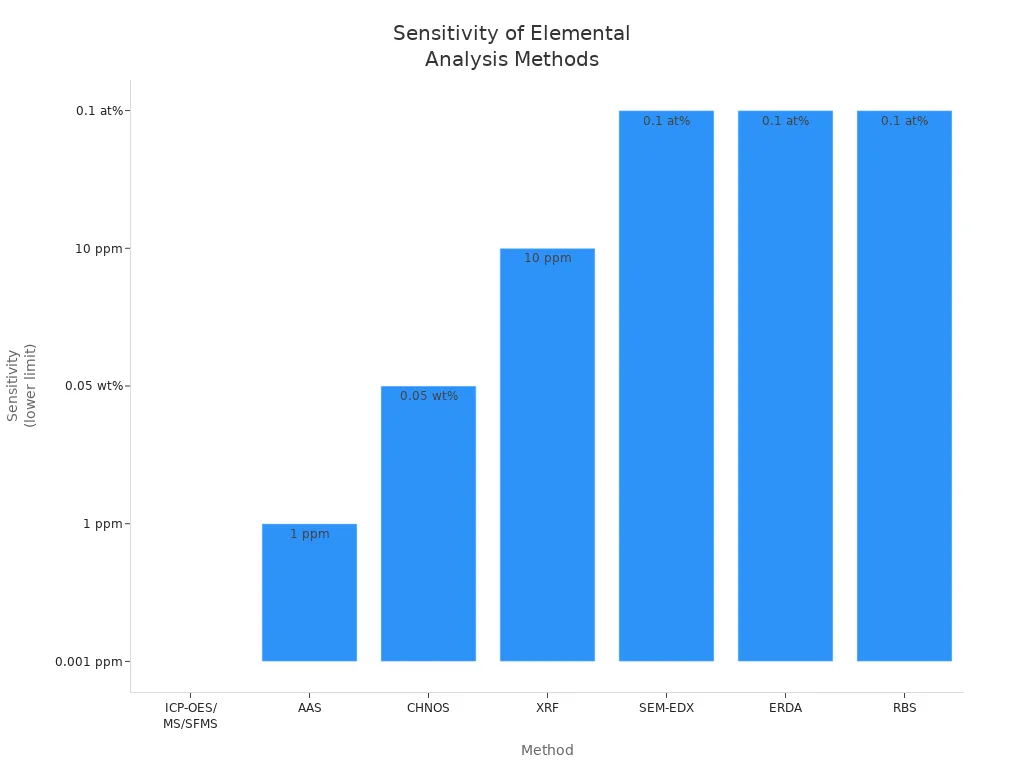
You can compare EAM techniques with other elemental analysis methods. The table below shows how different methods detect elements and their sensitivity:
You can see that EAM techniques, especially ICP-MS, offer high sensitivity. This helps you detect even tiny amounts of harmful metals during Food Testing.
DNA-Based and PFAS Testing Methods
You use DNA-based methods to find bacteria and viruses in food. Polymerase chain reaction (PCR) is the most popular DNA-based test. In 2023, PCR made up 37.4% of the market share for Food Testing. You can use PCR to test dairy, meat, poultry, seafood, processed foods, and beverages. PCR helps you find pathogens quickly and accurately.
You also need to test for per- and polyfluoroalkyl substances (PFAS) in food. PFAS are chemicals that can harm health. Recent advances in high-performance liquid chromatography (HPLC) have made PFAS testing more effective. New column materials and high-resolution mass spectrometry help you find PFAS at very low levels. Improved sample preparation, like solid-phase extraction, increases recovery rates and reduces errors. These improvements help you get reliable results when you test for PFAS in complex foods. Note: Using the right DNA-based and PFAS testing methods helps you meet FDA standards and keep food safe for everyone.
Food Testing and the FDA Regulatory Framework
Key FDA Standards and Guidelines
You need to follow strict rules when you test food in your laboratory. The FDA sets standards to make sure your results are accurate and reliable. The Laboratory Accreditation for Analyses of Foods (LAAF) Program is one important rule. This program tells you how to get your laboratory accredited and what you must do to meet FDA requirements. You must use a LAAF-accredited laboratory for certain situations, like import alerts or food safety problems. The FDA checks these laboratories to make sure they follow the rules and give correct results.
Here is a table that shows the main FDA regulations for food testing laboratories:
Regulation/Program
Description
Laboratory Accreditation for Analyses of Foods (LAAF) Program
Establishes standards for laboratory accreditation and outlines requirements for food testing laboratories.
Compliance Requirements
Owners and consignees must use a LAAF-accredited laboratory for specific food testing scenarios, including import alerts and food safety issues.
FDA Oversight
The program enhances FDA oversight of participating laboratories to ensure accuracy and reliability in food testing.
Tip: Always check if your laboratory meets the latest FDA standards before you start Food Testing.
ISO/IEC 17025:2017 Accreditation Requirements
You must also know about ISO/IEC 17025:2017. This is a global standard for laboratories. It helps you show that your laboratory can produce valid results. You need a strong quality management system. You must follow national and international rules for testing. You also need to meet guidelines from AOAC International and APAC TC 007.
Here is a table that lists the main requirements for ISO/IEC 17025:2017 accreditation:
Requirement
Description
Quality Management System
A full system assessment of the laboratory’s quality management system is required.
Technical Requirements
Adherence to recognized national and international accreditation criteria is necessary.
Guidelines
Compliance with AOAC International Guidelines and APAC TC 007 Guidelines for Food Testing Laboratories is essential.
You can use these standards to improve your laboratory and make sure your Food Testing results are trusted.
Implementing FDA Food Testing in the Laboratory
Preparing Documentation and Records
You start by preparing clear documentation before you begin Food Testing. You gather material specifications, safety data sheets, and any previous test results. You keep records organized so you can find information quickly. Good documentation helps you track each step and proves that you follow FDA rules. You update records after every test to show what you did and what you found.
Sample Collection and Handling Procedures
You follow best practices to collect and handle samples. Here is a simple process you can use:
Gather all needed paperwork, including safety data sheets and past results.
Collect samples that truly represent the food or material you want to test. Use clean, non-reactive containers to avoid contamination.
Send samples to an accredited laboratory that uses FDA-approved methods.
You label each sample clearly. You store samples at the right temperature to keep them safe. You avoid mixing samples to prevent errors.
Choosing Accredited Food Testing Laboratories
You choose laboratories that have proper accreditation. You check if they meet ISO/IEC 17025:2017 standards. Accredited labs follow strict rules and use approved methods. You trust their results because they meet FDA requirements.
Selecting Appropriate Testing Methods
You selecttesting methodsthat match the food type and the risks you want to check. You review FDA manuals and guidelines to pick the right method. You make sure the method is up to date and fits your laboratory’s equipment.
Interpreting and Reporting Food Testing Results
You read results carefully and compare them to FDA safety limits. You report findings in a clear format. You include all details, such as sample ID, test method, and results. You share reports with the right people so they can make safe decisions. Tip: Always double-check your results before you send out reports. Accurate reporting keeps food safe and builds trust.
Method Validation and Development in Food Testing
FDA Guidelines for Method Validation
You need to follow strict guidelines when you validate new methods for Food Testing. The FDA created the Methods Development, Validation, and Implementation Program (MDVIP) to help you do this. The MDVIP gives you clear steps for validating methods in chemistry and microbiology. You must use properly validated methods, and multi-laboratory validation is important when possible. The FDA works with experts to develop and review analytical methods. You can find specific guidelines for chemical, microbiological, and DNA-based methods through the FDA. These steps help you make sure your results are accurate and reliable. Tip: Always check the latest FDA guidelines before you start using a new method in your laboratory.
Developing and Adapting New Food Testing Methods
You face new food safety threats every year. You must adapt and develop new methods to keep up. Laboratories use several strategies to respond to these changes:
You categorize food contaminants as biological, chemical, or physical.
You watch for risks caused by changes in population, economy, environment, politics, consumer needs, and technology.
You support research that looks for differences in food contamination prevention in different regions.
You work with international partners to use advanced detection technologies.
You improve Food Testing by staying alert and using new tools. You help protect people by finding threats early and sharing knowledge with others.
Training and Resources for Food Testing Professionals
Ongoing Staff Training and Competency
You need strong training to keep your laboratory team ready for food testing challenges. You help your staff learn new skills by offering regular workshops and hands-on practice. You encourage your team to review FDA manuals and updates. You set up training sessions that focus on real-life scenarios, such as handling new contaminants orusing advanced equipment.
You check your staff’s skills often. You use quizzes, sample tests, and peer reviews to measure progress. You reward team members who show improvement and share knowledge. You build a culture of learning in your laboratory. You make sure everyone understands the latest FDA rules and testing methods. Tip: You can use short training videos and interactive guides to help your team learn faster and remember key steps.
Accessing Authoritative FDA Resources
You find reliable information by using trusted FDA resources. You look for guides, catalogs, and educational materials that help you stay current with food safety standards. The FDA offers several resources that you can use every day:
Resource Title
Description
Resources for You (Food)
Comprehensive assistance from the FDA Human Foods Program, including educational materials and expert conversations.
Guidance on Health/Nutrient Claim Based on an Authoritative Statement
Information on health claims based on authoritative statements from recognized scientific bodies.
FDA Launches Library/Catalog of Food Safety, Nutrition, and Cosmetic Safety Education Materials
A catalog designed to provide accessible public health education information related to food safety and nutrition.
You use these resources to answer questions, train your staff, andimprove your laboratory’s testing methods. You stay informed about new rules and best practices. You help your team make safe choices for food testing every day.
You play a key role in food safety when you use FDA-approved testing methods. These methods help you meet strict standards and keep food safe.
What You Gain
Why It Matters
Reliable results
You meet ISO/IEC 17025:2017 and FDA rules.
Safer food
You protect public health and support safe commerce.

 +86-18343147735